Research Archives - Page 6 of 6 - Cromwell Property Group
A person typing on a laptop

Research and Insights

Home Research Page 6
December 19, 2017

Focus on Singapore: an emerging global financial powerhouse

From humble beginnings as a colonial outpost, Singapore is fast emerging as a premiere hub for investment and wealth management. With government initiatives such as ‘Smart Nation’ reflecting its go-ahead attitude, global investors are increasingly looking to Singapore for its capital raising potential and connectivity to other Asian markets.


Business and financial attractiveness

The latest international rankings demonstrate Singapore’s attractiveness as a regional headquarters for multinationals and other businesses, as well as its financial prowess.

The World Bank’s 2018 ‘Doing Business’ survey gave Singapore the second-highest rating among the 190 economies surveyed (Australia placed 14th by comparison).

Singapore also ranked highly in Z/Yen’s September 2017 ‘Global Financial Centres Index’ report, which placed the Lion City fourth globally, trailing only Hong Kong, New York and London among the 108 centres surveyed. Australia’s highest place was earned by Sydney, which ranked eighth.

Singapore was rated fourth-best for business environment, human capital, infrastructure and financial sector development, and third-best for its reputation. It also placed fourth-highest for banking, investment management and professional services.

By all accounts, Singapore’s success in the ratings demonstrates it has the capabilities and infrastructure to live up to its ever-increasing reputation as a major global financial centre.

Wealth industry expands

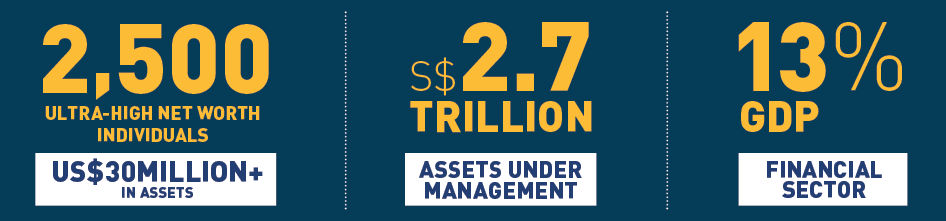
Other data also highlights Singapore’s strengths as a wealth management hub. Knight Frank’s 2017 ’Wealth Report’ showed that Singapore boasted some 2,500 ultra-high net worth individuals (UHNWIs) with more than US$30 million in assets, a ratio of 4.5 UHNWIs for every 10,000 people.

The ‘Knight Frank City Wealth Index 2017’ ranked Singapore sixth overall, a placing it is expected to improve on based on investment, connectivity and future wealth estimates.

Total assets managed by the nation’s 660 locally-based fund managers grew by 7% to reach S$2.7 trillion (A$2.6 trillion) in 2016, the Monetary Authority of Singapore (MAS) said in its annual survey.

The MAS said it aimed to further “deepen its venture capital and private equity capabilities,” with a simplified regulatory framework for venture capital managers planned by the end of this year.

The financial sector currently accounts for around 13% of Singapore’s gross domestic product (GDP) and employs 200,000 people, but the authorities are seeing potential for further expansion.

In October 2017, the MAS announced plans aimed at strengthening its status as a leading financial hub in Asia. Under its road map, Singapore aims to create thousands of net new jobs in financial services and financial technology by 2020, aiming to achieve real growth in the sector of 4.3% a year, faster than the overall economy.

“With technology transforming the way financial services are produced, delivered, and consumed, it is critical that Singapore’s financial sector also transforms, to stay relevant and competitive,” the MAS said.

The central bank will collaborate with financial institutions to create common utilities for services including electronic payments, as well as developing solutions for inter-bank payments and trade finance. It also plans to expand cross-border cooperation with other fintech centres to make Singapore a base for foreign start-ups.

The MAS also eyes making the nation Asia’s top centre for capital raising, enterprise and infrastructure financing, along with fixed income and insurance. It is already ranked as the world’s third-largest foreign exchange centre.

Focus-on-Singapore-1

Capital raising capacity

Singapore’s capital raising capacity is well established with more than US$1 trillion raised through debt and equity issues in the decade through to 2015. According to the Singapore Exchange (SGX), listed companies raised 50% more funds through the secondary market than at initial public offering stage.

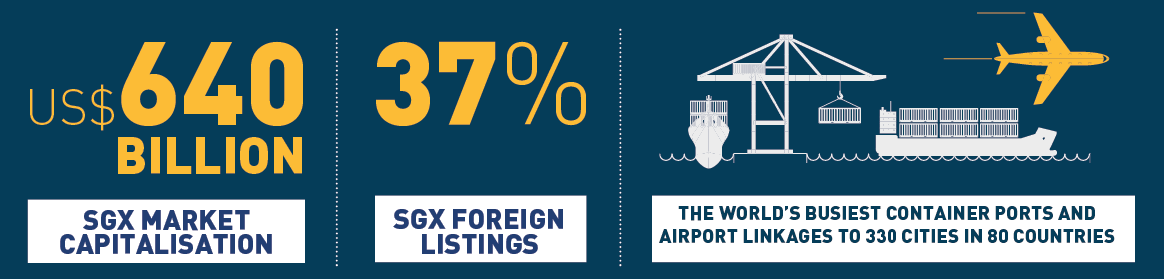
While the SGX had a market capitalisation of around US$640 billion at the end of 2016, just over half of Australia’s US$1.21 trillion, Singapore had a substantially greater proportion of foreign listings, with overseas companies making up around 37% compared to just 6% in Australia.

Singapore’s bourse states it is “the world’s most liquid offshore market for the benchmark equity indices of China, India, Japan and ASEAN…Headquartered in AAA-rated Singapore, SGX is globally recognised for its risk management and clearing capabilities.”


Location equals connectivity

The Singapore Economic Development Board (EDB) also points to the nation’s status as a global transportation hub, with the world’s busiest container ports and airport linkages to 330 cities in 80 countries, along with the most extensive network of free trade agreements in Asia.

A nation of just 5.6 million, Singapore is taking advantage of its central location and building on its potential, with initiatives such as ‘Smart Nation’ seeking to foster technological improvements across a range of areas, from business productivity to health, transport and the environment.

“As an open economy, Singapore is impacted by global forces – geopolitical tensions, potential threat of anti-globalisation, and technology disruptions across many industries…But Singapore has strengths and achievements that place the country in a good position to succeed,” the government’s ‘Smart Nation’ initiative states.

For a republic founded a little over 50 years ago, Singapore today is well on its way to becoming a global financial powerhouse and one of the world’s premier investment and wealth management destinations.

Focus-on-Singapore-2

A person typing on a laptop

Research and Insights

Home Research Page 6
October 11, 2017

The 2017 Australian commercial property outlook

Australia has experienced a period of strong demand for commercial property which has led to firming yields and high prices. There is still a substantial amount of investment capital looking for opportunity but the lack of availability of suitable stock has led to a reduced volume of transactions during 2016. Most property markets are, or are close to being, fully valued.

Going forward, rising bond rates and slow to moderate economic growth will have an impact on property markets. As growth stays below long term trends, and rates rise, prices will soften.

In this type of environment, leasing conditions will re-emerge as the primary driver of property outcomes. The key question is the extent to which growth in net effective rental income will offset the negative impact of rising interest rates on yields.

Office property markets

Cyclical factors will have a greater influence on prices in office property markets than that of rising interest rates on yields. The key is to invest in strong leasing markets with prospects for strong rental growth.

Sydney remains the pick of the markets. Demand has been improving moderately but with development virtually stopped and stock availability declining due to the Metro rail project and increased residential conversions, falling vacancy rates have meant strong rises in effective rents as leasing incentives reduce.

Vacancy rates are forecast to be less than 5% for the next three years, driving further rises in net effective rents and property prices. However, strong capital growth over the last year has reduced prospective returns. There are still opportunities for investment, and this is the phase where repositioning, major refurbishment or new developments can generate returns, but each opportunity needs to be examined on its own merits.

Last year, demand for office space was moderate in Melbourne. But, unlike Sydney, there has been plenty of development to satisfy requirements. In the short term, Melbourne will be hit by a weakening of demand as it absorbs the loss of the remaining car manufacturers and many associated suppliers, as well as a slowdown in residential construction.

Once that shock is absorbed, however, Melbourne will recover. It still retains many of the advantages—notably cheap land for residential, commercial and industrial property—which gave it a competitive advantage over Sydney in the provision of back-office services for national operations. Melbourne office demand will grow slightly more strongly than Sydney in the next decade but rent and property value growth will be inhibited by the plentiful availability of sites.

The Brisbane economy is still suffering from the continuing loss of demand from mining services. In the boom, 25% of Brisbane’s office space was occupied by companies servicing mining. Demand will be hit further when the inner Brisbane apartment market turns down.

Medium term, the prospects are good as Brisbane will benefit from strengthening activity in tourism, education services and agriculture. The short term will be difficult due to the existing oversupply of office space with little prospect of a substantial improvement in demand to absorb it. The vacancy rate is currently above 15% and will still be above 10% at the end of the decade.

The Perth economy is collapsing under the weight of the end of the mining boom. Investment has further to fall and the economy will stay weak for some time. During the boom, half of Perth office space was occupied by companies servicing mining. Much of that demand is now gone and the vacancies will take a decade to absorb. Rents and property values will fall a lot further.

Adelaide is suffering from weak demand and oversupplied office space. Although the worst may be over in terms of demand-side weakness, there is no prospect of sustained growth for a couple of years as the local economy deals with the closure of the GM Holden plant. The patrol boats, frigates and submarines projects will help but not until the end of the decade.

Canberra remains a difficult market. We are coming to the end of the period of substantial oversupply and A grade vacancies have tightened everywhere except at the airport, where there is still plenty of space. However, new construction is about to get under way in Civic, while some secondary properties lie vacant and are difficult to lease.

Retail property markets

Regional and sub-regional centres

Retail property remains a highly popular investment. The volume of transactions reached record levels over the last few years and only a shortage of regional centres for sale has constrained the market. Some existing owners are instead now ploughing additional capital into centre refurbishment/expansion projects.

Retail yields have firmed aggressively over the last few years and are averaging around that of the last market peak. Yet retailing conditions are not nearly so strong. Growth has been slowing in trend terms since early 2014. While larger retailers and chains are outperforming smaller retailers, there have nonetheless been several high profile failures in the last few months.

The soft economy and weak household income growth will continue to constrain retail expenditure for the rest of this decade. Strong regional differences will emerge as former mining boom areas suffer, while those regions dependent on tourism, education services and other sectors that benefit from a lower Australian dollar enjoy stronger growth.

Shopping centre net operating incomes face further challenges from the poor performance of many anchor tenants and likely pressure on retailer profit margins (and hence their capacity to pay higher rent) from a lower Australian dollar. Changes in tenancy mix, a greater reliance on food and beverage retailers and service sector tenants, and costly upgrades will be required to protect against these threats.

Despite the challenges, centre incomes are, to a great extent, protected by anchor tenant rent and rents from non-expiring specialties on fixed annual escalations. Yields could remain low for some time but they will eventually follow bond rates up.

Large format retail

The large format retail property sector enjoyed another strong year in 2016 across a range of indicators. Strong demand from both consumers and retailers helped to push vacancy rates lower, in turn encouraging rental growth. Meanwhile, the investment market is buoyant.

However, the surge in consumer spending is now past and activity is at more moderate levels. This comes at a time when supply of centres is likely to surge after seven weak years. Reconfiguration of ex-Masters stores into centres could add up to 700,000 square metres of ‘new’ centre floor-space. Moreover, there are also 21 development sites to be accounted for.

Smaller existing centres and strip shopping locations are likely to be the main losers to the ‘new’ ex-Masters centres. Larger, dominant centres are unlikely to suffer as much. Bunnings is a clear winner in the whole process, with a major competitor gone and a great opportunity to pick up new sites easily.

Longer term, the outperformance of larger retailers and chains is expected to continue. Even so, it will be no match for the pace of growth in the 2000s.

On the investment side, demand remains strong. A record dollar value of transactions was achieved in 2015–16. The strength of investor demand has pushed down yields with further yield firming likely over the next 12 to 18 months. Rising bond rates, already putting upwards pressure on yields, will win out after that. Prime values are likely to stagnate rather than fall, but secondary centres could see a drop in prices.

Retail looks reasonably valued, with expected returns around current investment hurdle rates. Even so, retailing and retail property face major challenges. Large format retail has the best estimated return, reflecting its higher yield. Its low rent and expansion opportunities will help it to absorb the Masters properties and secure the longer term strength of the sector, but in the short term there are risks from the amount of reconfigured Masters floor-space likely to come on to the market.


Industrial property markets

The years of strong investment returns from industrial property are coming to an end, with the period of falling interest rates that had underwritten firming yields and strongly rising asset values now over.

Softer future yields will have a negative impact on valuations and also on construction feasibility, requiring higher pre-lease effective rents to underwrite the financial feasibility of development projects. The transition to higher rents will be relatively smooth, though the risk is that it may take a year or longer. If this occurs, falling vacancies would eventually deliver the necessary step-up in rents.

Industrial property development is running close to demand. Ready availability of land and development competition is keeping a lid on residual land prices, rents and property values, suppressing a cyclical upswing. That makes it less risky but slightly overvalued in relation to market hurdle rates.

Summary

This is an uncertain time for property investors. After a long period of falling interest rates driving firming yields, we are on the threshold of a phase of rising interest rates. The uncertainty is how quickly and by how much interest rates will rise. When they do, yields will soften but that will be offset by the impact of rising rents.

This suggests that yields may have a little further to firm before the impact of rising interest rates comes through.  Meanwhile, continuing soft economic growth means continuing weak demand, in the transition to a post-mining boom economy. The result is marked differences in performance between industries and regions. There are no obvious standout investments, and each investment opportunity needs to be examined on its own merits.

A person typing on a laptop

Research and Insights

Home Research Page 6
July 11, 2017

Mid year 2017 economic and property outlook update

Overview

The thrust of our January 2017 Economic and Property Outlook Report (Insight, Summer 2017) remains unchanged. We still see a phase of rising bond rates coming, and a corresponding softening of yields and asset prices. This will affect all asset markets, including property. The search for yield which has been prevalent over the last few years will transform into a search for income growth.

A focus on income growth means a continued focus on the Sydney office market. The strength of the Melbourne economy means that Melbourne offices can also be considered. There may also be some emerging regional tourism-related opportunities, but Brisbane, Perth and Adelaide will remain difficult environments for investors. Asset selection, as always, is of paramount importance.

Economic update

Patchy gross domestic product (GDP) growth has confirmed our view of continued slow economic growth, a weak labour market, soft household income and retail sales and contained inflation. The structural shift from mining regions towards non-mining business-related services and regions particularly Sydney and Melbourne continues.

In Brisbane, the full impact of the fall in mining investment was delayed by a shift of resources to building inner city apartments. The impending residential apartment downturn will have a negative impact on the economy. Perth also remains weak, with further negative impact expected, as the remaining gas project finishes.

Housing interest rates have already risen through rising bank margins, particularly for investment and interest-only loans. That, together with tightening loan to valuation ratios (LVRs) and equity pre-commitment requirements on developers, will take the heat out of the high-rise residential boom. It is much harder to get a project away now. Hence the widespread recognition of the impending downturn in residential property and building markets. The negative shock of this downturn will mean continued soft overall economic growth.

Two further US Federal Reserve rate rises have also confirmed that we are embarking on a phase of rising cash and bond rates. This is particularly important for property investment markets through the relationship between bond rates and yields (see our article “Making sense of commercial property yields” in Insight, Winter 2017). In Australia, cash rates will remain low for some time. However, bond rates have already started to rise and will continue to do so in step with the US.

Property markets update:

Office markets

The Sydney office market has gone from strength to strength, with tightening leasing markets driving effective rents, firming yields and further property price growth. With strong business growth forecast to come, we believe that the Sydney office market has further to run, and even at substantially higher prices, on a five-year horizon Sydney commercial property is (broadly speaking) undervalued in relation to forecast expected returns. These conditions point to the possibility of a 1980s-style boom.

The strength of the Victorian and Melbourne economies has resulted in upgraded growth forecasts, with a flow-on to the office market. The loss of the motor vehicle industry and parts of the power industry have had an impact, but the economy and employment have been good over the last year, suggesting continued strong, albeit lower (than Sydney), growth in Melbourne.

For 20 years, Melbourne has had a comparative advantage over Sydney. Readily available and cheap land for residential, industrial and office developments has contained rents and property values, making it a more cost-effective place to situate back-office functions for national operations. That will continue to boost the demand for office space and we have increased our forecasts of demand, rent and price growth in the Melbourne market.


Development phase

The Sydney and Melbourne office markets are entering a substantial development phase which will change the logic of office investment. Over the next ten years, 3.3 million square metres (sqm) of office space in Sydney and 2.3 million sqm in Melbourne will be built. Given that some of these developments will be refurbishments, net additions will be circa 2.4 million sqm in Sydney and 1.5 million sqm in Melbourne.

This development phase and net additions of this quantum will eventually have an impact, and five year forecast returns are much stronger than ten-year forecast returns for both Sydney and Melbourne. Repositioning and exit strategies will be needed to manage this cycle.


Canberra, Brisbane, Perth and Adelaide Office

The Canberra office market should see strong prospective returns over both short and long terms. Canberra’s oversupply is easing, particularly for better quality space in Civic. However, the risk to be considered is that Canberra remains a dominant tenant, two-tiered market.

Despite strong recent sales, it is early for countercyclical investment in the Brisbane, Perth or Adelaide office markets. They face a period of weakness before they absorb the excess stock created during the boom.


Other asset classes

Amongst other property classes, weak retail sales growth and the impending arrival of Amazon have heightened emerging concerns about the strength of retailers and centre returns for retail property. The property risks are heightened for weaker centres, but returns to strong centres should remain solid.

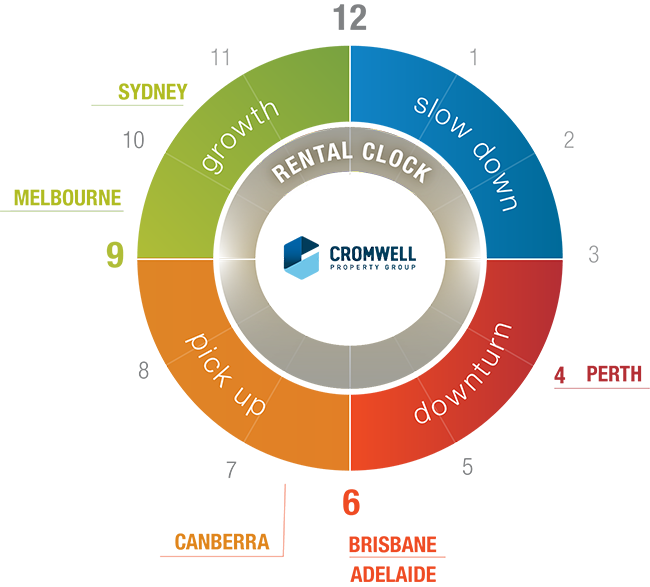
Stage of the Property cycle

Stage of the Property cycle

Industrial property is still recovering from the GFC. Availability of land is keeping development highly competitive. Recent strong returns have been driven by firming yields, allowing a reduction of effective rents and some rises in land values. Rising bond rates and softening yields will reverse this, squeezing development feasibilities and leaving returns solid but not spectacular.

The current hotels development boom is focused primarily on business travel in capital cities. The boom will oversupply business travel markets and the use of investment apartments as serviced apartments may potentially worsen matters further (think Airbnb). As recreational tourism continues to recover over the next decade however, there will be a need for more tourist hotels and services in regional markets.

During the recent period of falling interest rates, investment returns were boosted through the impact of lower rates on yields and asset prices. This happened, not just for property, but for all asset classes including infrastructure, equity markets and, of course, bonds. Rising interest rates will unwind a lot of these gains, causing a softening of yields and prices across the board.

It is now evident that we are embarking on a phase of rising interest rates worldwide, driven initially by US Federal Reserve cash rates, underpinning higher bond rates. Indeed, expectations of further cash rate rises will cause bond rates to rise by more than cash rates. It’s not yet clear how quickly or how far bond rates will rise but the recognition that they will do so will encourage investors to switch from the search for yield to a search for income growth.

Asset returns over the next five years will generally be lower than the last five. That includes infrastructure, equities and bonds, as well as property. Currently, weight of money is still driving firming pressure on yields, even in low growth markets. This will eventually change and investors should begin to look for rental growth to drive values and total returns. In that respect, the Sydney and Melbourne office markets are the obvious candidates.

A person typing on a laptop

Research and Insights

Home Research Page 6
March 29, 2017

The 2017 Australian economic outlook

2017’s outlook is a continuation of key themes from our 2016 report. The themes have been reinforced by recent developments including volatile GDP growth, softening retail sales growth, slowing employment growth and significantly higher bond rates.


Overview

Australia’s transition to a strong post-mining boom economy continues to be slow and difficult. The lower dollar will help but there will still be significant negative shocks, headwinds and structural change. The successful outcome of the transition will depend on our ability to rebuild non-mining industries, starting with the dollar-exposed export and import-competing industries and flowing on to services.

GDP growth has come off a high of 3.1% at the start of 2016 and will continue to soften to average around 2.5% over the next three years. Employment growth, which peaked at just under 3% in 2016, will average 1% over the next three years, with the unemployment rate drifting up to 6%.

The medium term is still a story of slow structural change with many bumps on the road. However, already we can see the first signs of this change in the strength of tourism and international student education services. But there’s a long way to go before business investment comes through as a driver to strengthen economic growth and complete the transition.

Transition involves substantial structural economic change

We are only two thirds of the way through an estimated three quarters decline in mining construction. The negative shock it brings to economic growth will continue for another two to three years.

Fortunately, this is being offset by strong increases in mining production and exports as investments move into the production stage. Headline GDP growth has been saved by strong export and production volumes.

In many mining regions however, weak demand, lower employment and reduced incomes make it feel like a recession. Take out mining production (which has little flow-on to the rest of the economy) and it is a recession in these regions.

The mining boom involved a structural change towards an economy servicing high levels of mining investment. There was a huge boost to activities and employment related to design and engineering, development and regulatory approvals, construction, equipment, implementation and installation of services, through to other support sectors such as administration, legal and accounting. The boost came in both the mining regions and the capital cities (mainly Perth and Brisbane) servicing the mines.

The resultant boom and high dollar destroyed the competitiveness of Australia’s dollar-exposed export and import-competing industries. Many went into recession. Some like the car manufacturing industry were lost forever.

The flip side of the coin is that in a post-mining boom economy, a lower dollar will boost export and import-competing industries. They will be the first industries to invest, stimulating services and broadening into non-mining industries.

The world economy is still recovering from the effects of the global financial crisis

The GFC didn’t come out of the blue. It followed a ‘financial engineering’ boom which drove significant global over-investment. All being well it was always going to take a decade to absorb the excess capacity created during that investment boom. This has dominated world economic outcomes since.

Weak world growth and fears of financial after-shocks drove central banks to print money and lower interest rates. As many central banks have discovered the hard way, cheap money doesn’t necessarily stimulate investment where it makes no sense to do so.

Nevertheless, broadly speaking the world economy is tentatively on a path to slow and gradual recovery.

  • The US is growing again, with low unemployment. Fiscal policy initiatives and/or lower corporate tax rates from the new Trump administration will help further.
  • Europe is on a more difficult path with different national economies growing at different speeds.
  • The UK recovery, post-GFC, was aided by the low pound. Now, with uncertainty surrounding the implementation of Brexit, further falls in the pound will help cushion any additional negative shocks.
  • And then there’s always the fear that China’s growth will unwind.

Though these are all serious issues they will have relatively minor impacts on Australian outcomes. Australia’s current problems are primarily domestic.

Australian-dollar-us-dollar

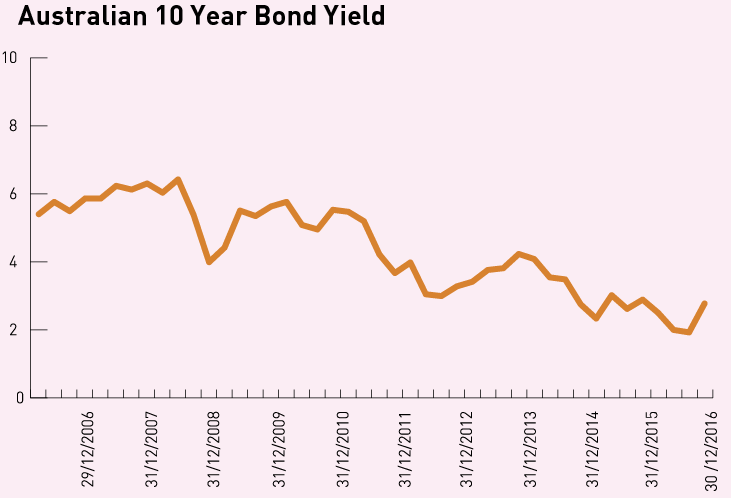
Australian-bond-yield


The start of a long phase of rising interest rates

Global growth, even tentative growth, brings back to the table the prospect of a long phase of rising interest rates. That comes after a long phase of falling interest rates, which has left interest rates worldwide at unsustainably low levels.

The US Federal Reserve is leading the world into the phase of rising interest rates. The Fed’s second interest rate rise last December has confirmed the process. What we don’t know is how quickly rates will rise and by how much. The consensus is that they will rise slowly but each rise will have a disproportionate impact given the low starting point.

In Australia, given the buffer between Australian and US rates, the RBA will keep cash rates low while the economy remains in transition, at least until US rates rise to Australian levels. The impact on bond rates however is more immediate. With little margin between Australian and US rates, we expect Australian bond rates to track US movements. This has already begun.

The Australian dollar has only a little further to fall

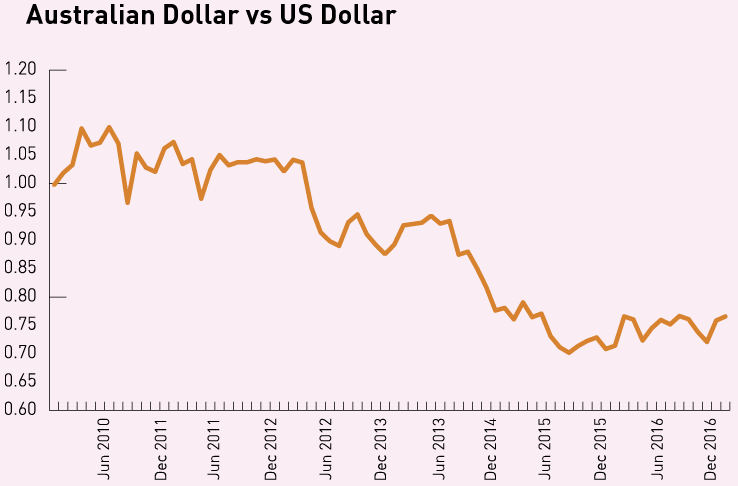
A narrowing in the differential between Australian and US interest rates will take pressure off the Australian dollar, but not by much. Further forecast falls in the differential with the US, as their interest rates rise, will take us from around $0.75 closer to $0.70 US. That should be enough to stimulate non-mining dollar-exposed industries.

Australia, too, is still recovering from the GFC.

While Australia didn’t experience an actual recession during the GFC, even now, close to a decade on, non-mining industries remain weak. Weak demand, weak profits and excess capacity have kept business in cost-cutting and cost containment mode as the primary way of increasing profits.

There are other cyclical factors in play:

  • The pendulum has swung strongly away from mining industries and regions. People go where the jobs are. NSW and Victoria are the strongest growth states, with the mining states weak. Regional shifts in jobs, industry and services will play a major role in future demand.
  • The residential boom is running its course as the high levels of building send some cities into oversupply. The Perth market has already started to fall. Apart from Perth, worst affected will be inner-city apartment markets in Melbourne and Brisbane. In the mining regions, falling housing demand has already led to a collapse in building and property markets.
  • Australia-wide, building construction will hold up as major projects are completed; the next stage is a significant downturn in residential building, with a corresponding negative impact on growth.
  • Infrastructure spending is growing after years of decline. Funding is coming from asset sales, with a boost from the Commonwealth. However, the magnitude won’t be enough to offset declines in mining construction and residential building.

Three years from now, the negative impact of falling mining investment will be over. At that point, non-mining business investment will have built momentum and be driving economic growth. Once that happens, growth will strengthen above 3%. The 2020s will be a stronger decade.

Meanwhile, we face three years of slow to moderate growth. That will keep inflation contained and allow the RBA to keep interest rates low. The level of growth will mask major differences between industries and regions. The ‘transition’ will continue to be a long and difficult process.

A person typing on a laptop

Research and Insights

Home Research Page 6
March 28, 2017

European property investment market update

There’s a lot going on in Europe this year. While last year was fairly tumultuous, 2017 promises much of the same, especially on the political front.

The fallout from the populist movements that have taken a grip across the Northern Hemisphere will continue. Following the charge to Brexit led by the flamboyant, if accident prone, duo of Boris Johnson and Nigel Farage, the world looked on aghast as Donald Trump was elected President of the United States, becoming the most powerful leader in the ‘free world’.

Next on the agenda are national elections in France, the Netherlands, Germany and perhaps Italy. Mainland Europe is also grappling with a colourful array of right-wing politicians hoping to ride their way to power on the back of the populist vote.

The Netherlands has Geert Wilders’ Freedom Party; France has Marine Le Pen leading the Front Nationale, or Marine as she likes to be known in an effort to distance herself from her father’s more extreme politics.

Germany, however, is predicted to be a calmer affair with the stalwart Angela Merkel running for a fourth term as Chancellor.

We believe that speculating about the outcome of this political drama and how it will change the face of the global economy is something best left to economists, a group, like the pollsters, whose predictions have come under increasingly widespread criticism in recent years.

We prefer to look at the facts and use our experience of having spent a lifetime working in real estate in the countries in which we invest to advise our clients on the best strategies to employ at any moment in time.

While the UK and the rest of the European Union work out the details of their divorce settlement, they will remain unavoidably reliant on each other for both trade and security. This is highly unlikely to change despite what some political commentators may say.

For all the hype that Brexit would destroy the UK economy, a look at the facts some six months on reveals a less apocalyptic outcome. Admittedly, we still don’t really know the details of the plan and some may argue it’s too early to tell, but the vote happened six months ago and that’s just the point: life goes on! Oxford Economics is currently predicting UK GDP growth of 1.6% in 2017, which is close to its estimate of 1.5% for the rest of Europe, while it also estimates that Q4 2016 UK growth should come in at 0.6%, which is in line with the previous two quarters.

Our team in the UK has first-hand experience of this. Following the referendum vote in June, we advised one of our clients to suspend the sale of a portfolio when the purchaser attempted a post-Brexit ‘chip’. In December, we brought the same portfolio back to market, selling it for more than the agreed pre-Brexit price. In the meantime, listed real estate share prices have bounced back, the FTSE is trading at an all time high and overseas investors continue to target real estate in the UK.

There have also been large currency fluctuations with the pound falling by 15% on a trade weighted basis since January 2016 and inflation is on the rise with the UK Consumer Prices Index forecast to average 3% for the year overall (Source: Oxford Economics).

What does this mean for investors looking to invest in Europe?

Perhaps the first and most obvious thing to understand is that while the European Union evolves or even disappears altogether, the collection of countries that is Europe will always be there. The EU is a relatively recent organisation, whose roots can be traced back to the end of the Second World War, but which was only formally established on 1 November 1993.

Europe is, and will remain for the foreseeable future, the second largest commercial real estate market in the world, comprising 32.5% of the total global volume (Source: RCA). Six of the top ten largest commercial real estate markets by size are in Europe. Within Europe, Paris alone boasts 40 million square metres of office space, approximately 2.5 times more than in the whole of Australia.

It is also the most liquid commercial real estate market in the world with cross-border capital accounting for 46% of all real estate transactions (Source: RCA).
The opinion of investors appears to support this view. A recent survey by INREV (European Association for Investors in Non-Listed Real Estate Vehicles) revealed that despite a backdrop of economic and geopolitical uncertainty, investors are optimistic about the prospects for commercial real estate.

The industry body estimates that €52.6 billion is earmarked for investment in real estate globally during 2017, an increase of €4.9 billion over last year. Of this, around €20 billion is targeted at Europe.

The UK, France and Germany are expected to attract the lion’s share of that investment with the UK and France coming in as joint favourites, followed by last year’s first choice, Germany.

Important source of diversification for real estate investors

In the current low-yield environment, pension funds and insurance companies are looking to diversify into commercial real estate as a way of accessing reliable, long-term liability-matching returns that used to be provided by the gilt of corporate bond markets.

While most of these institutions have invested in real estate for many years, most likely as part of a traditional core strategy, the level of sophistication in today’s real estate industry means that by moving up the risk curve to core-plus and value-add strategies, these investors are now able to access much higher yielding opportunities.

We estimate that a typical core strategy in Europe should be able to provide in excess of 8% total returns while a value-add strategy will generate between 12% and 14%.

For these investors, Europe is an attractive opportunity not only because of its size, but also because of its structure. As well as being the second largest commercial property market in the world, it is also one of the most heterogeneous, providing investors with access to a collection of idiosyncratic markets, each with its own unique profile of cities, buildings and tenants.

There are currently some really good opportunities in selected European markets to turn good quality assets into core real estate that will generate reliable income and some capital return. For example, we have identified some reposition to core opportunities for shopping centres in parts of the Netherlands and France. In Germany, the spread between prime and secondary office CBD yields is at a long-term high.

Most people who have worked in the industry or have had property exposure for long enough have lived through the highs and lows of various economic and political cycles, and experienced the effects, both positive and negative, on their real estate investments. The political events unravelling in Europe and elsewhere today are no different. The one truism to remember is that life goes on, and property markets endure!