paulphare, Author at Cromwell Property Group - Page 2 of 2
A person typing on a laptop

Research and Insights

December 9, 2019

Suite dreams are made of these: Hotels hit the big time

Hotels have long been grouped into the category of ‘specialty’ property, alongside the likes of seniors’ living, student accommodation and even data centres. However, as investors continue to look for alternatives to the mainstay real estate sectors, the hotel market has become an increasingly acceptable option for many institutional investors.

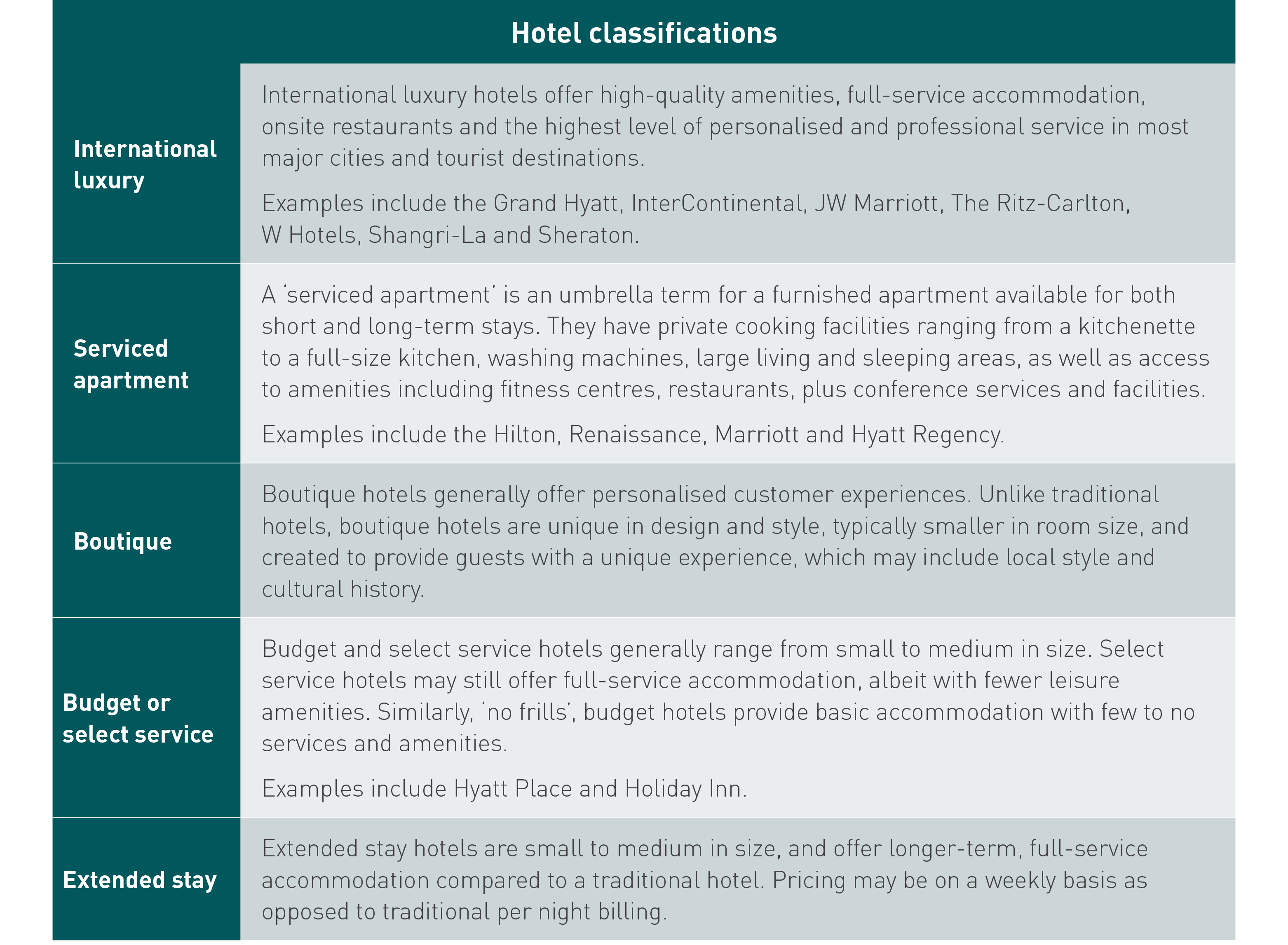
Hotel service classifications

Hotels are categorised in numerous different ways, including star ratings, size of hotel and number of rooms, location, ownership and affiliation, and also the type of hotel which is aligned to its offering.

The most common types of hotel markets include business, airport, resort or leisure, casino, convention and conference hotels.

Hotel classifications spreadsheet


Hotel dynamics

The hotel asset class possesses a number of key differences when compared to some other real estate sectors.

Owner or operator

All hotels require an operator, but whilst the operator and underlying investor (or owner) can be one and the same, particularly for boutique hotels, this is not necessarily always the case.

Many larger branded or chain hotels tend to have a mix of several ownership types including direct ownership, management contracts or franchise arrangements. For example, just because the name says Hilton, does not mean the Hilton Company owns the property.

Hotel rooms are perishable goods

A hotel room, like an airline seat, is a perishable good. That is, once a specific date occurs, every room not booked for that night perishes. Similar to airline seats, there is no market for yesterday’s rooms.

This presents a challenge as every hotel obviously wants as many rooms as possible booked each night, albeit the temptation is often to discount the room. Ongoing discounting, however, can damage a hotel’s brand and lead to other challenges.

Pricing fluctuates greatly

Hotel prices are put through a rigorous prediction process. Pricing rooms is not as simple as knowing when peak and off-peak seasons are. Rather, the hotel looks at the past year’s demand and compares it to larger trends correlating with the wider hotel industry. These include the economy of the country in which the hotel is situated, competitors’ prices for similar rooms, and even weather patterns.

A hotel will also look at its booking history. In doing so, the hotel seeks to identify the ‘booking curve’ in order to understand the optimal number of rooms that should be booked at certain intervals in advance (generally one, two and/or three months).

The overarching goal for every hotel is to ensure the most rooms are booked per night, at the highest price possible. As such, during stretches of lower demand or if actual bookings are lower than projected, room prices can be decreased to incentivise last-minute booking. On the other hand, prices are generally raised when demand is high.

Booking platforms are important

Online booking platforms have become an important tool to ensure the greatest possible number of rooms are occupied on a nightly basis, particularly when demand is low during off-peak times.

Third party agency sites such as Booking.com act as an intermediary between guests wanting to make a reservation and a hotel. These platforms also have a broader reach compared to a hotel’s own website, so while they can direct additional bookings to a hotel, they also charge for the privilege. This, in turn, eats into the hotel’s profit – hence why hotels usually advertise that the best rate is obtained by booking direct.

Loyalty programmes

Almost every major hotel chain has a loyalty programme to encourage travellers to stay with their chain wherever they travel across the globe. Similar to airline loyalty schemes, their hotel counterparts offer varying levels of membership and rewards for staying with a particular chain, or group of hotels.

Global hotel market summary

While slower global economic growth is expected to provide a headwind, hotel investment volumes are expected to hold steady in 2019 as a result of pressure to deploy capital, hotel occupancy and room rates remaining positive and the attractive yield profile hotels generally offer compared to other sectors.

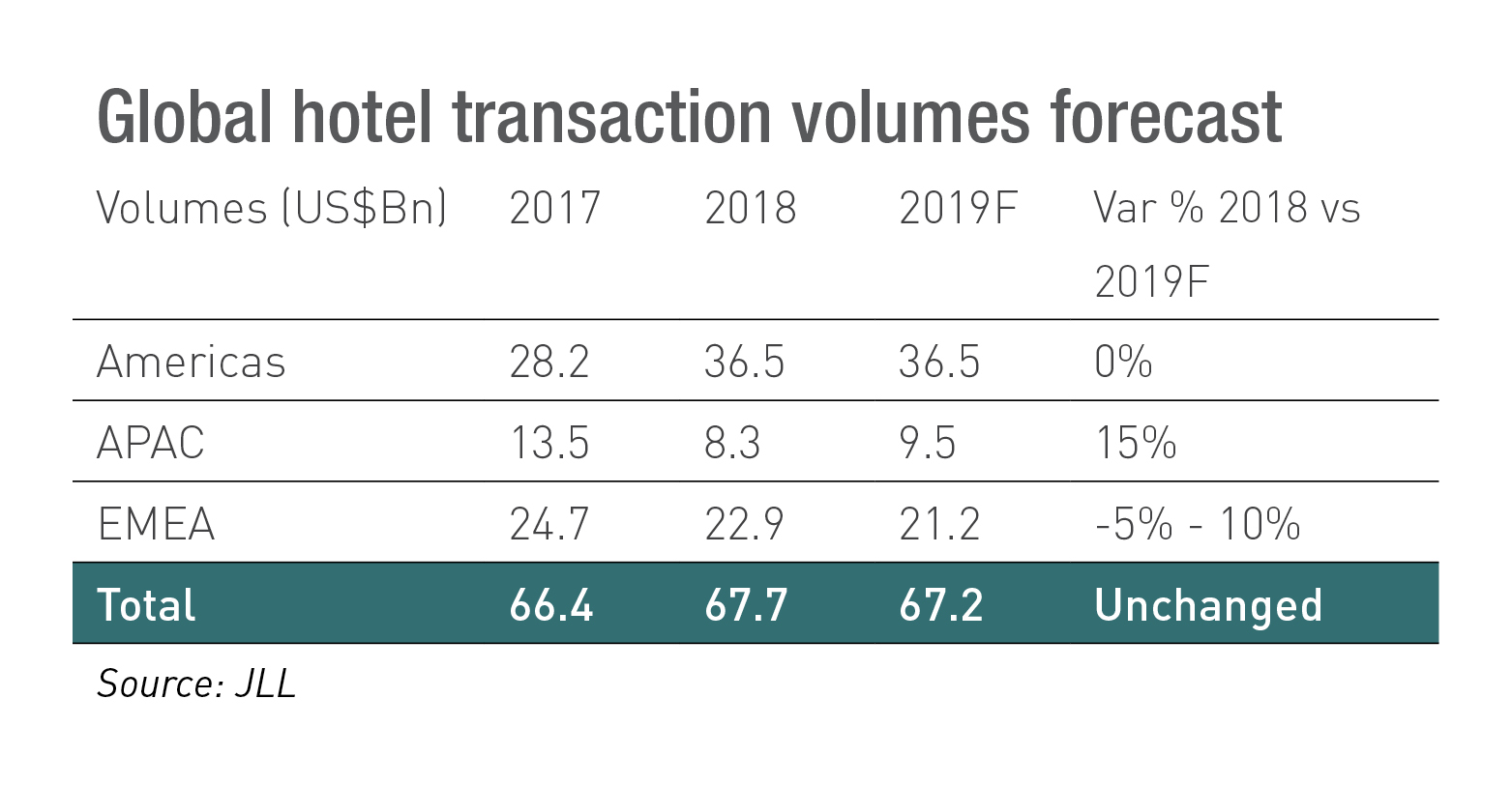
Volume in the Americas is expected to be flat, while an increase in Asian markets is expected to offset a slight decline in Europe. It is expected that total transaction volumes will be US$67.2 billion, essentially unchanged from 2018’s US$67.7 billion.

Global hotel transaction volumes forecast spreadsheet

Europe

Single-asset deals are expected to dominate in the near term. The lower volatility in the return profile of hotels reduces the volatility of funds, while slightly increasing the returns. As such, hotel assets provide a stabilising effect to the diversified funds to which they are added.

Overall, transaction volumes are anticipated to drop between 5% and 10% on 2018, to just over US$21 billion. However, the sentiment towards the asset class remains largely positive, as demonstrated by the acceleration in hotel development activity.

Germany and the UK account for nearly 60% of rooms under construction across Europe. These two markets are expected to absorb the additional supply across the medium term off the back of the strong tourism growth forecasts.

In 2018, Europe received the largest amount of cross-border investment, largely attributed to Asian and Middle Eastern investors. The region is expected to remain an active destination, particularly from Asian investors who are keen to take advantage of currency benefits.

Asia Pacific

Diverse sources of core and core-plus capital are increasingly weighing up investment into hotels. Japan is one of the most active markets due to the Rugby World Cup and Tokyo 2020 Olympics, but China and Singapore are also on investors’ radars, with the positive trend in hotel trading performance set to drive prices upwards.

APAC activity is expected to see a 15% year-on-year increase in 2019, although transaction volumes will still be a modest US$9.5 billion.

All eyes on Japan

Through the first half of 2019, Japan’s hotel market recorded the highest domestic transaction volumes in Asia Pacific at US$1.14 billion. Japanese REITs accounted for almost half of this investment, with demand rising off the back of low borrowing costs and expectations of continued market growth as a result of large-scale events such as the 2019 Rugby World Cup, Tokyo 2020 Olympics and the 2025 World Expo.

The Rugby World Cup is responsible, in part, for the 12% increase in international visitors forecast to descend on Japan throughout 2019. It is reasonable to anticipate an even greater increase in 2020, as 10 million visitors are expected to attend the Olympic Games.

Even though Tokyo will have 170,000 rooms in 2020, up from 30,000 in 2017, a number of prominent hotels are already hanging ‘no vacancy’ signs for the Games, illustrating continued strong demand for at least the next few years.

Americas

In the US, large portfolio deals are expected to dominate investment. Transaction volumes across the Americas in 2019 are forecast to meet the $36.5 billion mark set in 2018. Despite no year-on-year growth, this is still up significantly on the region’s US$28.2 billion transacted in 2017.

2018 represented the tenth consecutive year of growth in North America’s hotel performance, although it appears as though the development pipeline has reached its peak and begun to slow. This has resulted in increased confidence amongst investors, particularly in major markets such as New York.

Key growth drivers and future trends

Mixed-use: Work, stay, play

Mixed-use buildings, combining hotel, residential, office and/or retail space in a single building or precinct have gained increased traction in recent years. Mixed-use buildings increase diversification for investors and allow them to blend their offerings to meet the increasing demands of their guests.

Millennials moving in

Demographics are a major consideration for all hotel investors and operators. In Australia, millennials on average spend the most on accommodation per night. This gives rise to an emerging challenge, particularly given the growing rise of Airbnb amongst this demographic. Hotels must create a point of difference to ensure they continue to attract customers in the face of this popularity.

Rise of the global middle class

The rise of the global middle class also shows no signs of slowing, increasing from 1.8 billion people in 2009, to a forecast 3.2 billion in 2020 and 4.9 billion in 2030. The bulk of this growth comes from Asia, which will represent two-thirds of the global middle-class population by 2030. As a result of this rapid rise, the sheer number of people looking to travel, and stay at a hotel, is growing quickly.

The experience economy

Consumers are also placing less emphasis on acquiring material goods, and more on seeking out experiences. This is particularly evident in the global luxury travel market, which is forecast to reach US$1.1 trillion by 2025, representing a compound growth rate of 4.3% between 2017 and 2025.

This growth is driving demand for hotel stays and investors are looking to capitalise. In 2018, the US saw luxury hotel transactions rise by 76% year-on-year. In Europe, investors are looking to deploy capital to meet this demand in key destination cities such as Paris, Rome and Florence.

Investor diversification

Investors are also seeking alternative options to the traditional real estate sectors of office, industrial and retail to diversify their returns. As pressure mounts to deploy capital, the positive longer-term dynamics continue to heighten the appeal of hotel assets. Across the five years to 2018, 70% of hotel investments were made by investors looking to diversify, rather than those seeking hotel-specific funds.

Hotels, like any other asset class, have positives and negatives as an investment option. However, there is a lot to like about the sector, including its ability to diversify investor portfolios and sustained medium-term growth in demand off the back of the experience economy, tourism boom and continued rise of the global middle class.

Hotel infinity pool with two people looking at the view of the city

A person typing on a laptop

Research and Insights

December 9, 2019

The US$80 trillion world economy at a glance

The infographic below shows the composition of the US$80 trillion global economy in 2017, the most recent year in which comprehensive figures were available. In nominal terms, the US still has the largest Gross Domestic Product (GDP) at US$19.4 trillion, making up 24.4% of the world economy, nearly 60% larger than China at US$12.2 trillion.

However, in 2016, the International Monetary Fund called the Chinese economy the world’s largest when adjusted for purchasing power parity (which allows you to compare how much your money can buy in relative terms).

Perhaps a more telling statistic is that per capita disposable income is US$39,513 in the US and just US$2,993 in China. This more aptly illustrates just how far China has yet to go to give its citizens a similar quality of life.

The next two largest economies are Japan (US$4.9 trillion) and Germany (US$4.6 trillion). It’s India (US$2.6 trillion), however, which has now passed France and, given Brexit, probably also the UK, which is increasing the fastest. Brazil, despite its very recent economic woes, surpassed Italy in GDP rankings to take the number eight spot overall. Canada rounds out the top ten.

Australia’s GDP was US$1.32 trillion or 1.67% of the global economy, which just about puts it on par with Spain. While punching above Spain and most others in terms of GDP per capita, Australia remains a relatively small economy in global terms.

The infographic below shows the composition of the US$80 trillion global economy in 2017, the most recent year in which comprehensive figures were available. In nominal terms, the US still has the largest Gross Domestic Product (GDP) at US$19.4 trillion, making up 24.4% of the world economy, nearly 60% larger than China at US$12.2 trillion.

However, in 2016, the International Monetary Fund called the Chinese economy the world’s largest when adjusted for purchasing power parity (which allows you to compare how much your money can buy in relative terms).

Perhaps a more telling statistic is that per capita disposable income is US$39,513 in the US and just US$2,993 in China. This more aptly illustrates just how far China has yet to go to give its citizens a similar quality of life.

The next two largest economies are Japan (US$4.9 trillion) and Germany (US$4.6 trillion). It’s India (US$2.6 trillion), however, which has now passed France and, given Brexit, probably also the UK, which is increasing the fastest. Brazil, despite its very recent economic woes, surpassed Italy in GDP rankings to take the number eight spot overall. Canada rounds out the top ten.

Australia’s GDP was US$1.32 trillion or 1.67% of the global economy, which just about puts it on par with Spain. While punching above Spain and most others in terms of GDP per capita, Australia remains a relatively small economy in global terms.


Why diversify?

Australia has often been called the lucky country, given its more than 25-year run without recession. Luck, however, is not a strategy, nor is it sufficient to build a business, execute a strategy or pay distributions. Luck can run out and, diversification, whether or not it’s for personal investing or growing a business, is important.

Diversification doesn’t mean turning your back on what you know or are familiar with (Australia), but it does mean prudently assessing opportunities which can diversify investment portfolios or business income streams both by sector and by geography.

The European real estate market, for example, comprises approximately 350 million sqm of office stock, over 14 times more than the Australian equivalent. The market comprises more than 34 different individual office markets, each with more than 2 million sqm of office space.

To put it in perspective, that’s 34 different markets the size of Brisbane or Canberra that you can choose to invest in. All of these locations will have different local market dynamics, are at different points in the real estate cycle and are in differently performing countries, some of which, like Poland, currently have better prospects than Australia. Diversification matters.
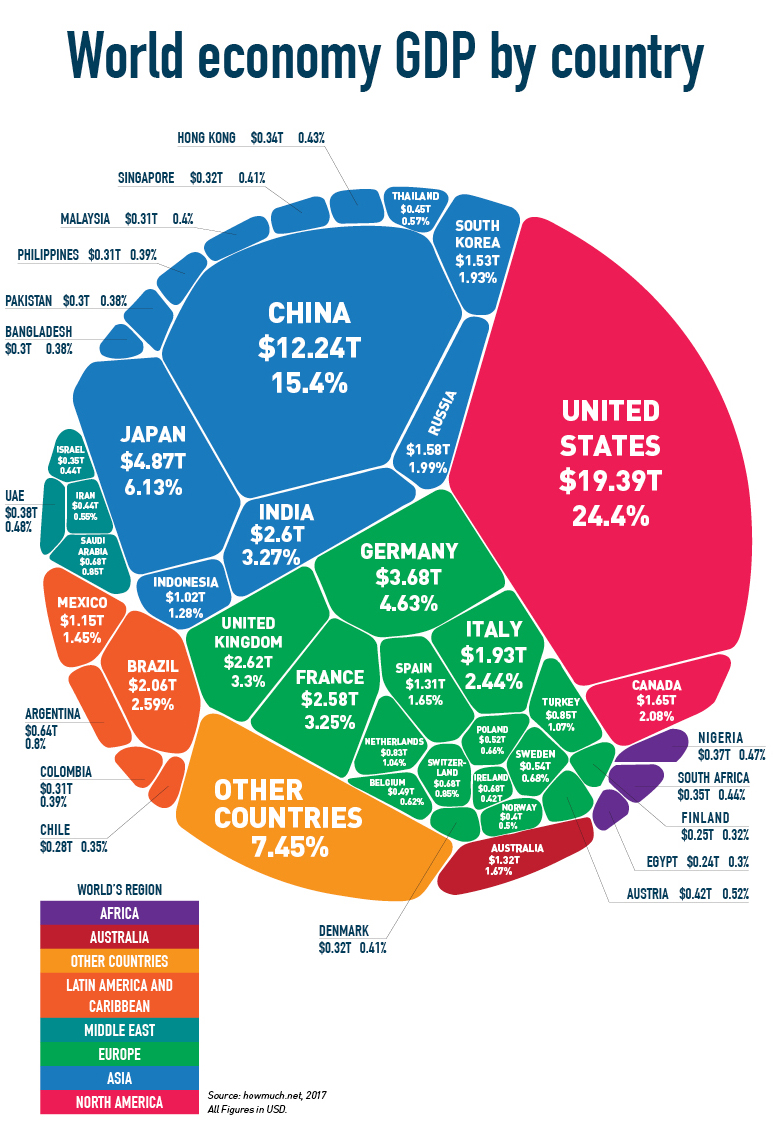

 

World economy GDP by country

A person typing on a laptop

Research and Insights

December 9, 2019

The importance of catchment in retail

In Insight 27, we provided an overview of the changes currently being experienced by the retail sector globally. The retail landscape varies dramatically from country to country. However, across all borders and economies, understanding the importance of catchment is vital.

Catchment refers to the sphere of influence from which a retail location – for example, a shopping centre – is likely to draw its customers. The general concept of a retail catchment area comprises three major considerations – supply factors, demand factors and consumer interactions.

On the supply side, there is the strength of the offering in terms of a centre’s quality, age, size, location and tenant mix. Alternatively, demand factors include location, population and demographic makeup of the catchment area. The supply and demand factors, in turn, dictate consumer interactions. A centre with a better offering will draw consumers from greater distances than centres with few points of difference to its competitors.

There are, however, a number of other important catchment-related considerations. Firstly, the position of a retail centre within the hierarchy of other local retail centres. This is determined by the format and size of the centre, population density of its catchment, the competitive intensity, and how well its proposition fits the needs of the consumer base.

For example, a high-end boutique centre with luxury fashion retailers would more than likely fare poorly in a low socio-economic area.

Generally, a catchment with a large population will have a greater retail offering, to the extent it acts as an employment hub and economic driver, thereby attracting customers from a wider area. A smaller, or remote catchment, will more than likely serve a different function, be more embedded in local economies and be patronised more frequently by local communities.

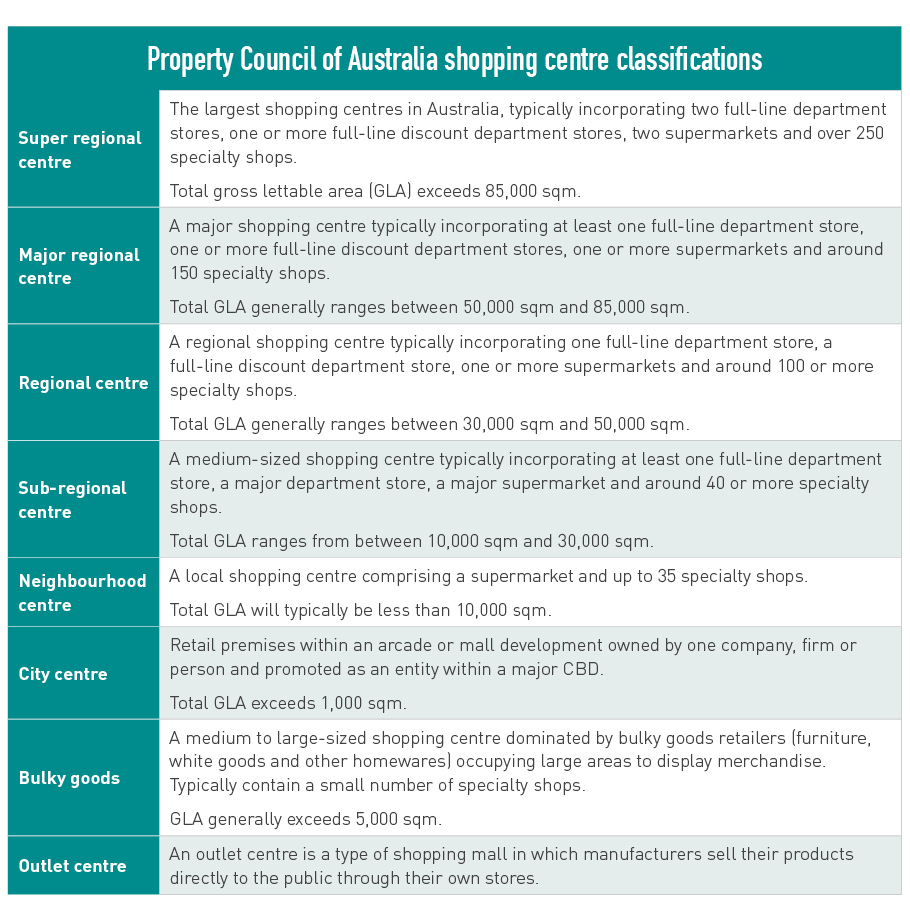
In Australia, the Property Council of Australia sets out classifications for shopping centres, which are closely aligned to the concept of ‘catchment’. This is shown below.

The importance of catchment cannot be overlooked. It is vital shopping centre investors and managers understand their catchment area in terms of socioeconomic status, size and demographics, and are able to tailor their offering accordingly.

Property Council of Australia shopping centre classifications spreadsheet